


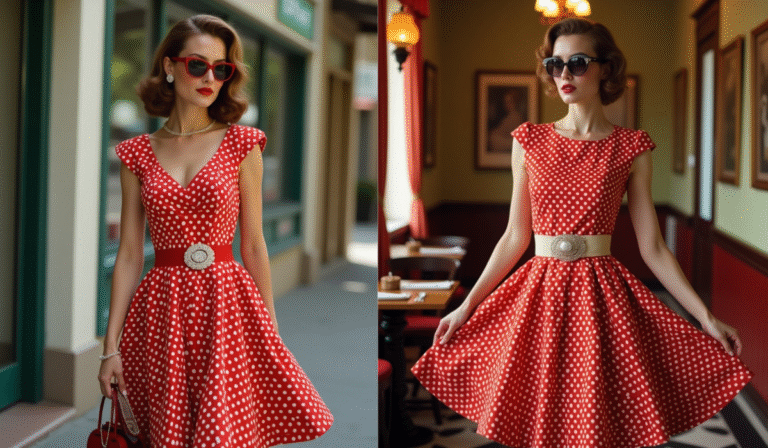
Retro-style dresses are not about nostalgia for its own sake. They are about understanding that the most elegant ideas in fashion were never meant to stay in one decade.
Some things age. Good design does not.
There is a reason women return, season after season, to the silhouettes of the 1950s, the boldness of the 1960s, and the unhurried ease of the 1970s. It is not sentimentality. It is recognition — the quiet acknowledgement that certain ideas about the female form, about proportion and movement and beauty, were simply right. They were right then, and they remain right now.
Retro-style dresses are not costumes pulled from a history book. They are contemporary pieces that borrow the intelligence of the past and apply it to the present. The distinction matters enormously. A woman in a beautifully cut fit-and-flare dress is not playing dress-up. She is making a considered choice about what flatters her, what endures, and what she wants to say about herself before she says a single word.
What Retro Actually Means — And What It Doesn’t
The word gets used loosely, so it is worth being precise.
Vintage refers to original pieces from a specific era — a genuine 1960s shift dress pulled from an archive or a lucky thrift find. Retro, by contrast, refers to contemporary clothing designed in the spirit of a past decade. The silhouette is borrowed. The fabric, the construction, and the fit are entirely modern.
This distinction is what separates retro dressing from costume wearing. A retro-style dress fits the body of a woman living today. It is cut from materials that breathe and move. It is tailored to modern proportions. What it carries from the past is something more essential — a design philosophy, a sense of shape, a relationship between the body and the cloth that the intervening decades have never quite managed to improve upon.
The Decades, Read Honestly
“Every era in fashion was, at its heart, a conversation about what women were allowed to be. The clothes we choose today are a continuation of that conversation.”
The 1940s and 1950s gave us structure. The nipped waist. The full skirt. The deliberate, almost architectural femininity of a woman who dressed as though every entrance was worth making properly. These were clothes built around the belief that elegance required effort — and that effort, when genuine, was always worth it. Polka dots on cotton. Satin at evening. A silhouette that said: I know exactly who I am.
The 1960s broke everything open. The shift dress arrived like a breath of fresh air — clean lines, lifted hems, a geometry that was almost defiant in its simplicity. This was fashion as liberation. The body no longer needed to be sculpted into an hourglass; it could simply exist, covered beautifully and without apology. Mod prints in electric blue and lime green. PVC accessories. An energy that felt, and still feels, like the future arriving ahead of schedule.
The 1970s exhaled. After the precision of the sixties, this decade dressed in earth and movement. Maxi dresses that swept the floor. Wrap silhouettes that moved with the body rather than against it. Velvet, paisley, warm terracotta tones that felt organic and unhurried. The 1970s understood something the other decades sometimes forgot: that comfort and beauty are not opposites.
The Elements That Make It Work
Retro dressing, done well, comes down to three things: silhouette, fabric, and restraint.
Silhouette first, always. Before colour, before print, before accessories — the shape of the dress is the entire argument. A fit-and-flare that sits correctly at the waist and falls to the right point on the knee will look polished in almost any fabric, in almost any setting. A wrap dress that skims rather than clings works on almost every body. Getting the silhouette right is not vanity; it is the foundation of everything else.
Fabric carries the decade. Structured cotton reads as 1950s. Fluid jersey reads as 1970s. Stiff geometric wool with a high hem reads as 1960s. When the fabric contradicts the silhouette, the dress stops working. When they agree, the result is effortless — the kind of outfit that appears to have required no thought at all, which is precisely what the best dressing always looks like.
Restraint is the difference between retro and costume. One strong reference per outfit is a statement. Three strong references at once is a theme party. Choose your decade and let one element carry the weight — a 1950s silhouette with contemporary jewellery, or a 1970s fabric in a modern cut. The past should whisper, not shout.
On Styling: The Details That Decide Everything
The dress is the foundation. What surrounds it determines the finish.
For a 1950s silhouette, the accessories should be considered but never overpowering. A single strand of pearls. Cat-eye sunglasses in tortoiseshell. A heel that is elegant without being theatrical. Red lipstick, if you are wearing it, should be the one thing in the room that demands attention — everything else should step quietly aside.
For 1960s dressing, the accessories can afford to be more assertive. Chunky geometric bangles. Ankle boots in a block heel. A graphic eye rather than a full face of makeup. The 1960s were about confidence expressed through simplicity, and that principle holds today.
For the 1970s, layering is the language. Beaded necklaces at different lengths. A wide-brim hat worn with genuine ease rather than self-consciousness. Platform sandals that give height without apology. The bohemian aesthetic was never about trying hard. It was about appearing not to try at all, which paradoxically requires the most thought of all three decades.
Where to Wear It — and How to Read the Room
A 1950s tea-length dress in ivory lace remains one of the most reliably elegant choices a wedding guest can make. It is formal without being competitive, feminine without being flimsy, and sufficiently removed from contemporary trends to feel genuinely considered rather than simply seasonal.
A sequined 1960s shift dress is the cocktail party’s best friend — sharp, confident, and brief enough in length to feel modern while retaining all the structural authority of its era.
A 1970s maxi in a bold floral print is summer dressing at its most relaxed and assured. It requires almost nothing from you in terms of effort — the dress carries the occasion by itself — and yet it is quietly the most stylish thing in any warm-weather setting.
The principle in all cases is the same: let the dress do the work. Retro silhouettes were designed with intention. Trust that intention.
A Final Thought on Confidence
No dress in history has ever looked better on a woman who was uncertain about wearing it.
Retro dressing asks something of you that contemporary fast fashion generally does not: it asks you to have a point of view. To know which decade speaks to you and why. To understand your own body well enough to choose a silhouette that serves it. To commit to a look rather than assemble one by accident.
That commitment — that small, quiet act of knowing who you are and dressing accordingly — is the whole secret of style. It was in the 1950s. It was in the 1970s. And it remains, stubbornly and beautifully, true today.
The past has dressed us well before. There is no reason it cannot do so again.
Frequently Asked Questions
What is the difference between vintage and retro style? Vintage refers to original clothing from a specific era — genuinely old pieces with genuine history. Retro refers to contemporary clothing designed in the spirit of a past decade. Retro dresses are made today, with modern fabrics and construction, but carry the design sensibility of a bygone era. The distinction matters because retro dresses fit and move like modern garments while still carrying the elegance of the past.
Which retro decade suits me best? The honest answer is whichever silhouette flatters your natural shape. The 1950s fit-and-flare works beautifully if you have a defined waist. The 1960s shift is forgiving across almost every body type and particularly strong on taller frames. The 1970s wrap dress is perhaps the most universally flattering silhouette ever designed — it adjusts to the body rather than demanding the body adjust to it.
How do I avoid looking like I am wearing a costume? Commit to one era per outfit, not three. Let the dress make the statement and keep everything else contemporary. Ensure the fit is immaculate — nothing ages a retro look faster than poor tailoring. And resist the urge to accessorise every period detail at once. One strong reference, worn with confidence, will always read as style. Several strong references worn simultaneously will always read as fancy dress.
Can retro dresses be worn to formal occasions? Absolutely — and often better than contemporary formal wear. A 1950s tea-length dress is among the most reliable choices for a formal daytime event. A beaded 1960s shift dress handles a black-tie cocktail evening with complete authority. The key is choosing the right decade for the formality of the occasion and ensuring the execution — fabric, fit, accessories — is genuinely polished.
Is retro fashion sustainable? It can be, and often is. Choosing retro-style pieces over trend-driven fast fashion generally means investing in better construction and longer wearability. Sourcing genuine vintage pieces from secondhand markets takes this further — keeping existing garments in circulation rather than feeding the cycle of production and disposal. The most sustainable wardrobe is always the one built to last, and retro dressing, by its very nature, favours the enduring over the disposable.
